What happened
The DVB Project has presented a reference infrastructure for testing DVB-I services and the streaming components behind them. Sofia Digital is developing and supporting the project with Motion Spell and Télécom Paris through the GPAC project.
The setup combines livesim2, a live MPEG-DASH streaming simulator, with the open-source GPAC multimedia framework. It is intended as a reference implementation that other teams can study and test.
Why it matters
When implementations are tested with different sources and configurations, it becomes harder to tell whether a problem lies in the service, the player or the delivery chain. A common reference makes results easier to compare.
That matters for television over IP because a service spans discovery, service lists, packaging, delivery and playback. DVB-I adds a discovery and organisation layer over IP distribution, while still depending on compatible components across the chain.
Testing and formats
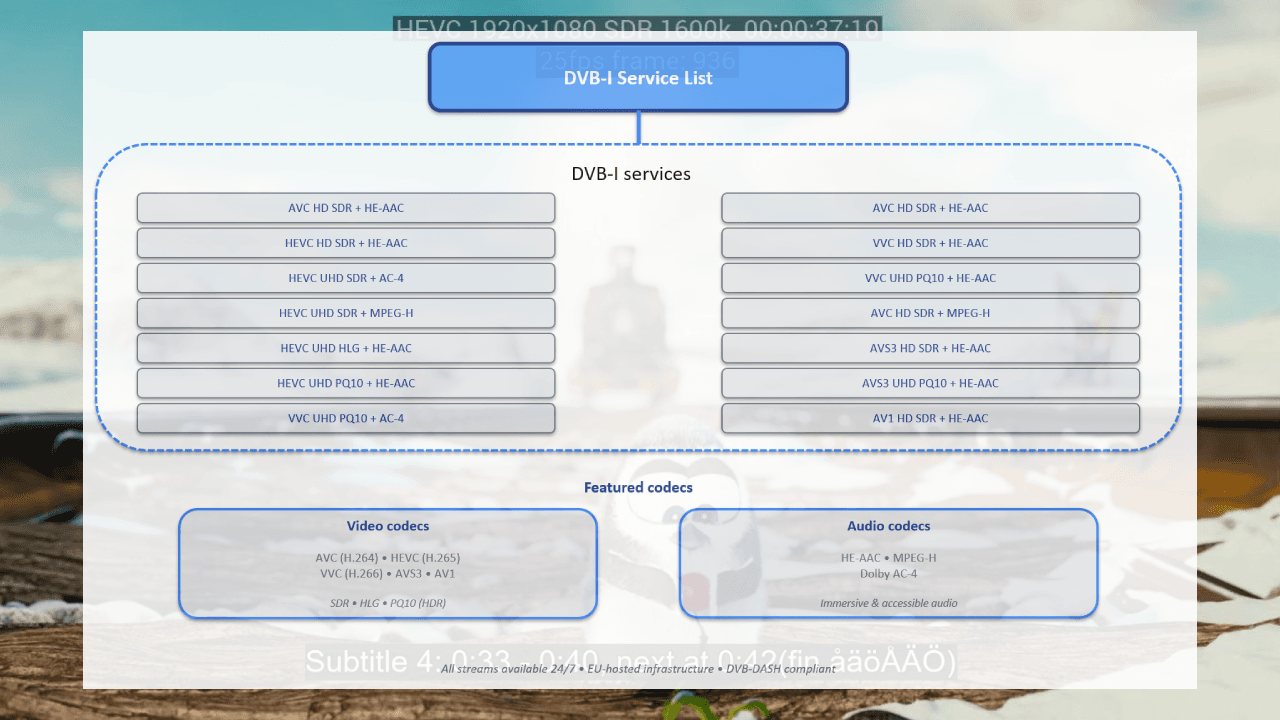
The infrastructure provides nine 24/7 live-linear streams for different test scenarios. It covers AVC/H.264, HEVC/H.265, VVC/H.266 and AVS3, together with HLG and PQ10 HDR variants. Audio options include AAC, MPEG-H and Dolby AC-4.
The DVB Project says the streams were checked for conformance, playback across multiple devices and players, and with a verification script informed by CTA-WAVE methodologies. DVB-I service lists and documentation for local installations are also provided.
The takeaway
This is not a new consumer television offer. It is a technical foundation for implementers and validation teams working with more reproducible scenarios as the DVB-I ecosystem develops.